Lire cet entretien en français / Read this interview in French
After Merav Svirsky’s parents were murdered on October 7th and her brother, Itay Svirsky, was kidnapped to Gaza, Merav found herself thrust into the forefront of the public struggle for the release of the hostages. It can now be said that this impressive and unique struggle, which lasted more than two years and defied the policy of the Israeli government, is what ultimately tipped the scales. Against all odds – by appealing directly to the US President and by taking to the streets – the Israeli public secured the release of those who were considered by many in Israel to be the ‘living dead’, individuals whose sacrifice was deemed permissible for achieving certain objectives.
It is hard not to draw a parallel between the cruel and concrete orphanhood that struck Merav and her family in a single day, and the symbolic orphanhood so many Israelis feel today because of the lack of accountability of their leadership and its refusal to take responsibility for the events of October 7th, 2023. I spoke with Merav in October 2025, after Trump’s speech in the Knesset and after the Kushners’ and Steve Witkoff’s visit to the Hostages Square in Tel Aviv.
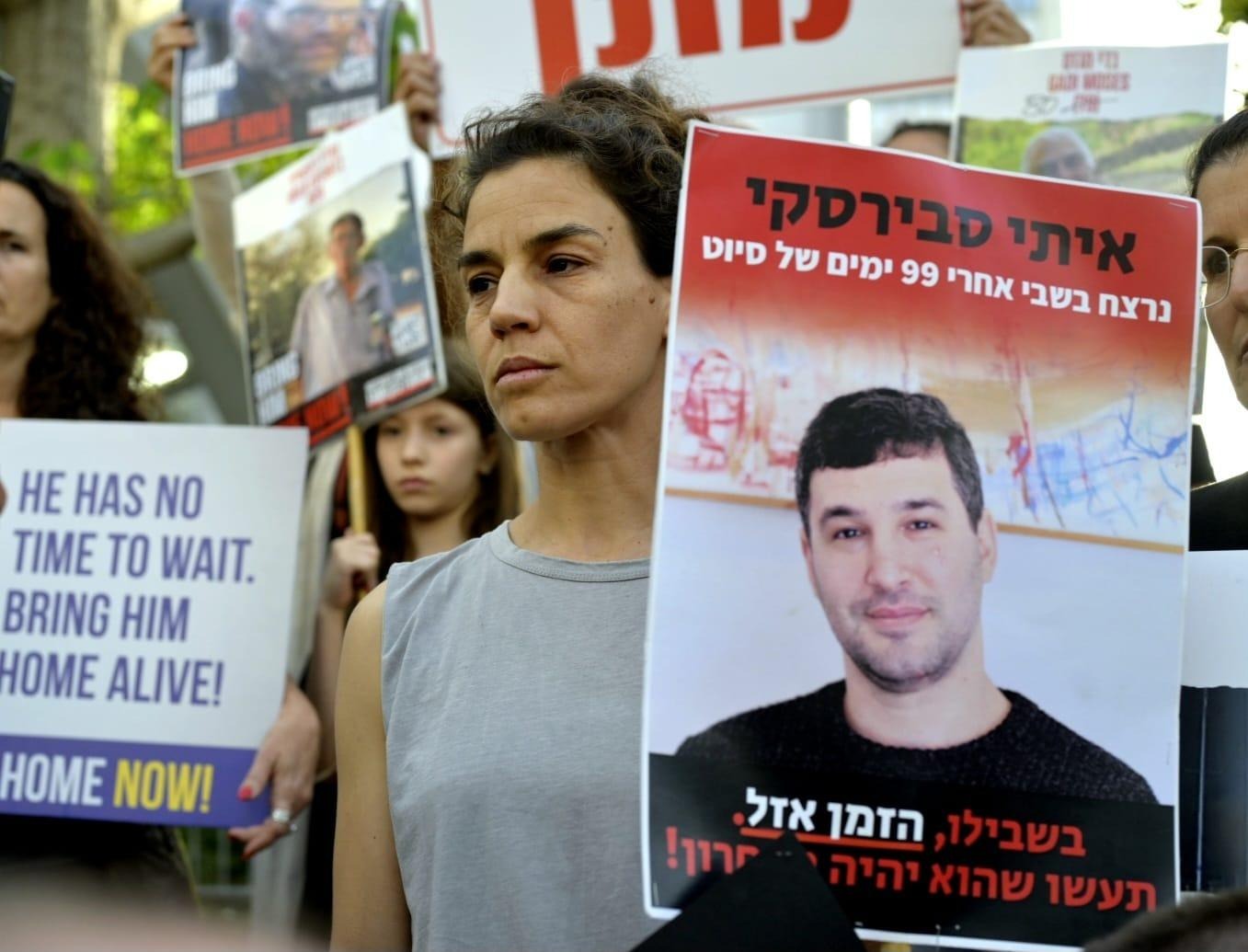
Shelly Alfred - Hello Merav. At some point over the last two years, I realized that I recognized your face from my time studying at the School for Visual Theater in Jerusalem many years ago. I am so sorry for what happened to you and your family.
Merav Svirsky – This happens to me with people who know me from the past and meet me after a long time. I immediately see the tears in their eyes, and I no longer understand why. It’s always very overwhelming. I carry this baggage with me everywhere. Everyone immediately apologizes.
SA - Your very presence is a vivid reminder of October 7th.
MS – In my case, I was deprived of the ability to distinguish between the private, the public and the national. One of the most fundamental things I have learned over the past two years is that living in Israel means living in a struggle. If we do not act to change things, we are consenting to accept an enormous disaster again. I refuse to act as victim.
SA - When did you realize that you would have to fight to get your brother, Itay, back?
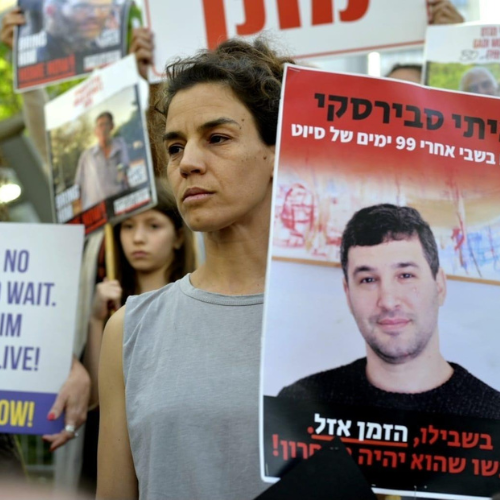
MS – On October 16th, we received official notification that both my parents (Orit and Rafi Svirsky z”l) had been murdered. Regarding Itay, we were not yet able to confirm that he was kidnapped. At the time, I was busy with the funerals, the shiva and my children. We were constantly receiving terrible news about friends and acquaintances. It was impossible to know who was alive and who was dead. We would sit in the evening, after a whole day of shiva with the children, trying to process the events, and in the meantime, countless horror stories would come in. It was chaos. I was sure at the time that the country’s leadership was working with determination to figure out how to bring them back. When the confirmation came that Itay was listed among the German hostages (he had German citizenship as well as Israeli), we then assumed that he had a real chance. Nevertheless, at the end of the shiva, I had a moment of great despair. I realized that it was not a given that Itay would return alive. From then on all I did was fight for his life.
SA - What made you figure that out?
MS – I was cut off from the media and news until my cousin informed me what was happening. He explained that the hostages were not on the government’s radar at that time, that they were not a war priority, and that there was no talk of bringing them back. The government was only concerned with revenge. This was at the end of October 2023. In terms of priorities, the hostages were somewhere near the bottom of the list. Suddenly it hit me that we were about to get into a tough fight that had nothing to do with justice. For me, it was obvious that the government would get its act together and try to save its citizens who were kidnapped from their beds in pajamas. In my opinion, the most important thing was to save human lives. I assumed responsibility would prevail over cynicism and that my country would live up to its obligation to be responsible for the lives of its citizens. I was naïve.
SA - So many people were kidnapped at once. It was shocking.
MS – True, but that’s nothing compared to the 1,200 people slaughtered that day. The hostages were treated as collateral damage, partly because no one knew yet who was alive and who was dead, but also because it was easy not to look the families in the eye. Only when the families started talking did it suddenly sink in that there were actual people who had been taken, who we knew were alive. We started meeting with members of the Knesset and ministers, regardless of their party affiliation. We wanted to meet with as many decision makers as possible to raise awareness and empathy for the stories, so that when the moment of truth came and a deal was put on the table, they would vote for it.
SA - Did you already know then that some ministers would not support a deal?
MS – Minister of Settlements and National Missions, Orit Strook from HaZionout HaDatit(The Religious Zionist Party), remarkably declared that on October 7th a miracle happened, because it led to the opportunity to conquer Gaza and settle there again. As far as ministers or coalition members like her were concerned, even if the hostages did not return, they would be willing to settle in Gaza over their dead bodies. They acted like the hostages were collateral damage, not the heart of the matter at all. The worldview of many in the government today is in no way related to the worldview upon which Israel was built – the Israel in which I grew up. Much of the sentiment here is revenge for the disengagement from Gaza in 2005 and the desire to return there. The vision of sacrifice for the sake of a Greater Israel is what drives them to action. I, however, am not here to sacrifice myself for the realization of an apocalyptic vision of the end of days or the Whole Israel, nor for the coming of the Messiah. These messianic and Kahanist voices are making a lot of noise and are being listened to, although, in fact, they are a small minority amongst Israelis. Wherever there is a vacuum, they make sure to fill it in.
SA - It's difficult to follow the complicated way the multiple deals for the release of the hostages unfolded. Looking at only the first and the last deals offers a sense of the complexity. In November 2023, the Israeli government approved a first deal to release 50 Israeli hostages – exclusively women and children. Three government ministers from the Otzma Yehudit (Jewish Strength) party voted against the deal: Itamar Ben-Gvir, Yitzhak Wasserlauf and Amichai Eliyahu. Later, Ben-Gvir 1 [1] boasted that he had thwarted several deals from taking place. The latest deal, in which 30 living hostages were released in January 2025, was opposed by eight government members, including members of HaZionout HaDatit and Otzma Yehudit.
A significant portion of the families' appeal to the public took place during Knesset committee discussions. A platform was created whereby each Knesset committee would begin by listening to the families and only then would the committee's own discussion begin. Guided by the principle that elected leaders are accountable to the voters, the idea was to keep the issue at the forefront by bringing it into every part of the Knesset. Did the way Knesset members respond to the hostages’ relatives change over time?
MS – At first, there was attention from all parties. You could feel the tears in people’s eyes and the desire to reach out. Slowly, however, Members of the Knesset stopped attending the first part. While families spoke from the heart, thinking that what they said would influence decision‐makers, the committee chairman would sit and stare blankly at his phone. Knesset members, mainly from the coalition, soon stopped coming in. They wore a mask of detachment and would wait in the hallway for someone to come out and tell them that this part was over. “Thank you, we'll take a break”, said the chairman. Then, the families would leave, Knesset members would enter and begin committee discussions as if they had nothing to do with the events of October 7th.
SA - Recently, members of Otzma Yehudit began wearing golden pins of a noose as a sign of their support of a death penalty law. From the distance, those pins look very similar to the yellow hostages’ pins. It is easy to interpret those death pins as another kind of a gimmicky symbol of defiance against the hostages’ families. We know today that Ben Gvir’s populistic declarations and actions throughout the war have had terrible and actual consequences to the hostages2 who were at the time being held in Gaza. Both Ben Gvir and Netanyahu were aware of this damage in real time because they were informed by the Shin-Bet.
When Knesset members were directly asked about what they were going to do to help the hostages, the most common statement was: “I'm not in the war cabinet, what do you want from me?” What was your reply?
MS – You are an elected official. You are a member of the party that forms the government, the same government which forms the war cabinet. You think you have no influence, but in fact you do. I sat for hours with Moshe Gafni (Member of the Knesset and leader of the Ashkenazi Haredi party, United Torah Judaism), who was at the time chairman of the Knesset’s important finance committee. I told him that he has much more influence than he thinks. Of course, in the end, his party threatened to leave and did indeed leave the government because of the draft law, not because of the failure to deal with the issue of the hostages.
SA - When did you start being attacked?
MS – We became a target once criticism began, for example, when we made clear demands to end the war, or made clear statements regarding the government’s failure to bring back the hostages. The ushers began to forcibly remove us from the committee room on the instructions of the chairman. I, too, was no longer willing to put up with the way in which they seemingly let us speak, but no one listened. It was part of the normalization of the horrid situation we were in, so we started staying for the committee discussions themselves and disrupted them. We were not willing to allow committee discussions to take place because talking was irrelevant when we knew living people were being tortured and killed an hour’s drive from Tel Aviv. It was difficult because many of the discussions dealt with issues related to other victims of the war – whom, of course, we cared about deeply – but saving lives was our priority. We could not accept their apparent indifference as if the Knesset had no responsibility for what was happening to the hostages in Gaza. I once said that the hostages are being sacrificed, and in fact, we are all being sacrificed. Member of Knesset Gutlieb went wild saying that the word “sacrifice” should not be used. This stopped the discussion. On another occasion, I said that we are entering a situation where our soldiers are being given illegal orders. They are being put in a situation where they may endanger the lives of hostages.
SA - Because they were asked to conquer Gaza and thus risked endangering the lives of the hostages?
MS – The head of the army, Eyal Zamir, informed the government that an operation to conquer Gaza would endanger the hostages. Despite this, the government and the war cabinet approved it. I’m quite certain that Zamir knew that if he refused the order, he would be dismissed like his predecessor. Therefore, I assume, he had to find a creative way to do what the government asked him to whilst trying not to harm the hostages in the process. In reality, they put the soldiers in an unreasonable and tremendously risky position, in which they had to ask themselves at every moment, and I know they did, whether what they were doing might endanger the hostages. Zamir did a great deal to prevent harm to the hostages, but ultimately, when soldiers were killed during this period, it was on his watch. Was it necessary to occupy Gaza to reach a deal ? That deal had been there since April 2024, in one variation or another. It was very similar to the deal we called the “Netanyahu plan” from May 2024. Bibi proposed it and Biden revealed it publicly, but then Bibi opposed it. In the end, it was Trump who implemented it. This agreement could have been signed much earlier and saved many lives – certainly those of the six hostages who were murdered at the end of August 2024, but also the lives of soldiers and many uninvolved civilians in Gaza.
SA - On this subject, it is worth watching Ilana Dayan's shocking television reportage on the death of those six hostages; Carmel, Hirsh, Eden, Alex, Ori and Almog z”l. How did you find out that your brother had been murdered in captivity?
MS – Itay was murdered on the 99th day. On the evening of the 100th day, Hamas released a video of psychological terror. In it, Itay, Noa Argamani and Yossi Sharabi introduced themselves, and then it said in the subtitles : “Who will live and who will die? You will know tomorrow.” The next day, a second video was released in which Noa said that Yossi and Itay had died, and Hamas blamed the IDF for it. We already knew that Itay was not alive, but it was not yet confirmed, and I couldn’t even tell my children. Today, we know what happened thanks to Noa, who got out alive and was with Itay until the last minute. On the 97th day, the building where they were being held was bombed by the IDF because it was suspected weapons were being aimed at them from that location. The IDF knew that Itay, Noa, and Yossi were in the area, but didn’t investigate thoroughly enough to understand exactly where. They prioritized dealing with a risk that seemed to be more urgent, and it ended up being at the expense of Yossi’s and Itay’s lives. In the bombing, Yossi was killed, Noa was injured and so was Itay. Two of their captors died and the third remained. A day and a half later, when the surviving captor moved them to another location in the middle of the night, something went wrong. Noa described him as nervous and acting differently. At some point, he took them aside, called out Itay, and then she heard a gunshot. We don’t know exactly what happened, except that there were bombings all around and the IDF’s forces were in the vicinity.
SA - This was before Noa Argamani's rescue.
MS – Long before, and before Hamas changed its orders, saying that if the IDF approached, the hostages should be shot. It wasn’t supposed to happen, but it was exactly what I had warned about endlessly : that we couldn’t predict what might happen once the army attacked. Ultimately, military pressure killed hostages. After Itay, many others experienced the same fate. Forty‐six hostages were kidnapped alive and came back dead. It could have been largely avoided if the government had prioritized saving lives first over revenge – if they had signed a deal in time.
SA - In your opinion, who brought back the hostages who did eventually return?
MS – It is clear that military pressure was generally necessary because we are dealing with a terrorist organization. I appreciate the sacrifice of all the soldiers who fought, including my family members who fought round after round, but ultimately, when military pressure is not translated into political action – it is meaningless, it causes damage that costs in human lives. In the end, despite our government, the agreement was signed thanks to Trump and the Israeli public, who kept the hostages as a top priority and took to the streets for them. We know for sure that the meetings with the families, and the knowledge that the Israeli public would not give up until they returned, had a huge impact on Trump. It didn’t affect our government, who couldn’t care less about us, but it affected Trump and global awareness. The message was conveyed : we would not give up on our people.
SA - Father of hostage Nimrod Cohen wrote that according to sources close to Trump, at the beginning of the war, Minister Ron Dermer, one of the closest people to Netanyahu, informed Trump that most of the hostages were dead anyway, so there was no need to rush into a deal.
MS – At the beginning Trump heard all kinds of numbers which he didn’t understand. Later that changed. The families insisted on meeting him, both people who had been recently released and those whose loved ones were still being held. The demonstrations with huge signs addressing Trump directly eventually influenced him. Miriam Adelson also helped explain to Trump what was happening within the Israeli public. If the masses had not taken to the streets, it would have seemed that only a few families cared. In this sense, the public’s struggle had tremendous significance. Of course, it was thanks to Trump, who pressured the Israeli government on the one hand and organized an Arab coalition that pressured Hamas on the other, that allowed us to reach this moment. This moment, however, is not over yet ; it must continue until all the bodies are returned and the war ends. Israel has failed here too, repeatedly, by not getting involved. When Bibi was invited by Arab leaders to attend the peace conference in Sharm el‐Sheikh, he canceled his trip. Israel refused to sign agreements and then a problematic agreement was signed without Israel. People today are rightly concerned about the Turkish and Qatari presence in the Gaza Strip. Why wasn’t the Israeli government there to initiate an agreement that would protect Israel’s security interests in the future ?
SA - How did you feel when Ivanka Trump, Jared Kushner and Steven Witkoff appeared in the Hostages’ Square – the same square the Prime Minister never visited – and gave you recognition and love?
MS – Look how crazy it is. The doors of both the German and Trump administrations were relatively open. In Germany, we received warm and respectful treatment with access generally being granted to the families of hostages with foreign nationalities. Here in Israel, we had to beg for a meeting with the war cabinet, with the defense minister, or with the prime minister. They didn’t care about the families, even though they bear direct responsibility for what happened. I watched the interview on 60 Minutes with Witkoff and Kushner. You can see that they were also acting from the heart. Obviously, there are many other interests here, but there is the human aspect too, which is lacking in Israel – in our own government. When it comes down to it, if it’s related to holding on to their seat, no matter what – they will always choose the seat.
SA - Hundreds of thousands of Israelis took to the streets week after week for people who are not their family members. They did everything they could to help bring back the hostages, which is to my knowledge, unprecedented in world history. In contrast, many other Israelis spat at you, cursed you, beat you up, and tore down the hostages’ signs. They wrote that you are selfish and do not care about the “general Israeli interest.” They expected you to keep silent. They labelled you the “religion of the hostages.” Hostages’ families were asked cynically how they would occupy themselves once the hostages returned, as if you took pleasure fighting for the lives of your relatives. Is there a civil war taking place within Israel?
MS – The situation within Israeli society is very difficult. In this respect, we have returned to October 6th. There is one person responsible for this : the prime minister. His government is unceasingly engaged in divisive and inflammatory rhetoric. Since the agreement was signed, the government has been busy creating a discourse of hatred against the families who were most active in the struggle. I should not have to ask my government to take responsibility or to guarantee the lives of its citizens ; that is its duty. We should not have to say thank you and fawn over them. The government is now knowingly working to discredit the families of the hostages, to turn the public against them, and change the narrative, including changing the name of the war to the “War of Revival.” They are working to distance themselves from responsibility. The best way to do this is to divide, incite and create fear : to label the hostages’ families as the bad guys who prevented them from achieving the celebrated “Total Victory.” The government continuously tried to scare us by suggesting that signing a deal with Hamas would make it impossible to defeat them – but, in fact, October 7th did not happen because Hamas was so successful ; it happened because we did not have a functioning country that day – and no one wants to investigate that.
SA - As a relative of victims of the October 7th attacks, did you feel that there were people in Israel working to discredit you, to intimidate you and to thwart the messages you wanted to convey?
MS – Absolutely.
SA - How were you intimidated?
MS – It’s difficult to pinpoint the methods used in psychological terrorism, but precisely this kind of terror worked in two ways from the very beginning. In terms of Hamas, I did not know whether every word I said could harm Itay in captivity or have a positive effect. The same goes for the Israeli government : would something I say raise or lower him on the list ? If I say something defiant, could they, on a personal level…
SA - Take revenge?
MS – Move him down the list of priorities. It’s not exactly one action or another, but rather the general constant feeling that we needed to make the government see that it’s in its interests – make the prime minister see that it’s in his interests to bring back the hostages. Although, as far as I’m concerned, it’s his duty. Obviously, a move to bring back hostages is not a simple one. It’s complex ; it has a heavy price. We never felt that the good of the citizens and the country were being put first, and not just the personal good of the prime minister and the survival of his coalition. The sense of security in the country was already shaken before October 7th. We felt that someone was pulling the rug out from under our feet and starting to change something fundamental here. There was a great deal of fear, including among my parents, who used to regularly demonstrate against the proposed judicial overhaul laws. We didn’t arrive at October 7th out of nowhere ; even before that, there was a noticeable lack of trust between a large portion of the citizens and the government.
SA - You are referring to the government's intention to promote a wide range of laws whose practical meaning was a fundamental change in Israel’s constitutional nature, which was set off by Yariv Levin’s declaration on January 4th, 2023. This speech moved masses of Israelis to take to the streets in regular and sustained demonstrations long before October 7th, 2023. Immediately after October 7th, all the organizations that had protested these laws shifted to helping civil society in a huge variety of ways, including assisting evacuated families and hostages’ families, filling in the vacuum left by an utterly dysfunctional government.
MS – It is impossible to separate the mistrust that existed before October 7th from what happened on October 7th itself and everything that has happened since. The way the government is rewriting history to erase and distance itself from the massacre is disgraceful. The struggle to bring back the hostages should not have been political at all. The citizens simply demanded a clear decision from the sovereign to take responsibility. My parents were very concerned about what happened here before the disaster, and then, when the moment of truth came, they really had no country to help them. They were so afraid of the undermining of the relationship between the state and its citizens. Their last experience before they were murdered was indeed that they had no army and no state at their side to protect them.
SA - Due to the government's refusal to establish a state commission of inquiry, we still do not know exactly what happened and why the army did not come. The powerful Israeli army failed the most basic task of any army, which is to defend the country's borders. I recently read a thorough investigation by Shomrimof how the government is trying to engineer and change the memory of the massacre. The prime minister intends to appoint none other than himself as the minister in charge of the memory of October 7th. It has major implications of the management of archival materials as well as budgets dedicated to memorializing October 7th. According to my research, Netanyahu did not attend any of the funerals of the victims of October 7th nor of any of the soldiers who fell during the following war, or any citizens, except for one single funeral. That was the funeral of Gal Eizenkot, the son of a minister in his government at the time, who was killed during his military service. Over 2,000 Israelis lost their lives until now due to October 7th and the successive war.
Many of the direct victims of October 7thfeel so betrayed by the government, that they themselves had to establish the October Council Forum, an organization with more than 1500 bereaved families, dedicated to “fighting for the establishment of a comprehensive state commission of inquiry in order to uncover the truth, bring justice to the bereaved families and prevent the next disaster”. The government is making every effort to eliminate the establishment of such an investigative committee. Will it ever be established?
MS – There is no substitute for an independent state commission of inquiry. An external examination must be made of both military and political systems, going back many years. There were countless warnings. We need to examine how the government’s policy, which for years strengthened Hamas and funneled money to “buy silence” affected Israel’s security. The Israeli government is currently waging a full‐scale war of perception against all those affected by October 7th. The government has not taken responsibility for the worst failure since the establishment of Israel, which occurred under its watch. It is not investigating itself and is not allowing a real, fair investigation. We will not allow the government to appoint its own investigators, as it recently did. Truth exists. There are facts that cannot be disputed. I know how Itay died. We know who was in power on October 7th. We know who systematically transferred unrecorded suitcases full of dollars in cash to Hamas. We know who repeatedly said : “Hamas is an asset”. We know who was working with Qatar before and during the war, and who constantly worked to manipulate Israeli public opinion. I repeat : the prime minister’s closest advisors, people whom he knew for years, received payments from Qatar before and during the war, whilst working at the same time in his office – the same Qatar which supports the Muslim Brotherhood all over the world and funded Hamas. The prime minister doesn’t even deny it. This government lacks legitimacy in so many ways. This failure has a name, and those who were in power are responsible for it. I don’t want to go to the Knesset, but I know that if I’m not there, the prevailing narrative will be different. They are completely shirking their responsibility for the massacre, the atrocities, the kidnapping.
With time I learnt that words can be powerful. The only thing I can do is explain and tell my story. My words can translate and create reality ; they can generate and influence discourse ; they can debunk the false narrative that’s being constructed about me. There is not a moment when I can sit back and tell myself that I am in a safe place. I cannot rest for a second, mourn my family, and feel protected and safe in my own country. We are constantly experiencing a double attack – from very dangerous enemies on the outside, and from within. It is necessary to make a clear distinction between the Israeli people and its government, whose interests are clearly not the same as those of the people.
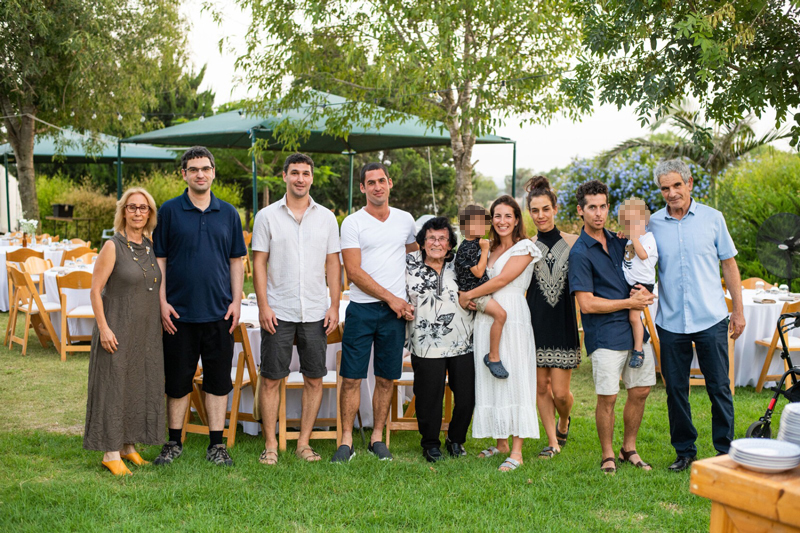
For Orit, Rafi and Itay Svirsky – May Their Memory be Blessed.
- Ben Gvir boasted many years ago that the emblem of Yitzhak Rabin's car got stolen. He said: “Just as we got to the car's emblem, we will also get Rabin.” As recorded here. Ben Gvir is now the minister in charge of the Israel police. ↩︎
- Read "Ex-hostage says Ben Gvir’s comments on prisoners led captors to beat them unconscious" on The Times of Israel and "Netanyahu ignored Shin Bet warnings that Ben-Gvir’s remarks led Hamas to abuse of hostages" on Ynet. ↩︎